Theme Table of Contents
VJIC Table of Contents
Photobooks, bookshops and awards
There are bookstores specializing in photobooks in many cities, but few are in small towns far from fast transportation networks like Zazie Books in Modica, Sicily.
I was attending a festival on artist books. These can be printed or unique pieces, made of paper, fabric or glass, in two or three dimensions… Some people make them as videos, or through embroidery, or by planting grass with chosen patterns. Roberto Muffoletto, editor and founder of Vasa Journal, was also there: he looked at all the books and suggested I write this series. Every day I walked past Zazie Books, the bookstore owned by Paola Contino, but it took me a while before going in. Then I looked, browsed, asked questions, and discovered that Paola not only runs a bookstore specialized in photography, but also has experience as a photobook editor and as a juror at festivals. Unfortunately for me, she is too busy to give me an interview, so I will limit myself to my reflections and the words we exchanged.
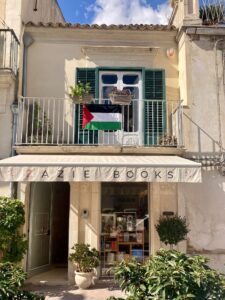
Before opening the bookstore, Paola worked in Rome for a small publisher of photobooks and did everything, including editing. She says that when she lays out a book, she needs to place all the prints on the floor and then move them around until she finds a convincing “story.” Her bookstore carries very diverse volumes, by Italian and international authors, including some vintage editions. It is clearly a passion, not just a job. It cannot be easy to run a specialized bookstore in Modica, a town famous for its chocolate and for being the birthplace of the poet Salvatore Quasimodo. There is an art high school, there are artists who live there, others were born there and live elsewhere, and still others have arrived from near and far and settled there. People even come from the United States to find a home. But without a car, it is not easy to get there. There is an important art gallery, which also represents Moira Ricci, and another that has recently opened, but not all artists work with photography. And not all photographers work with art.
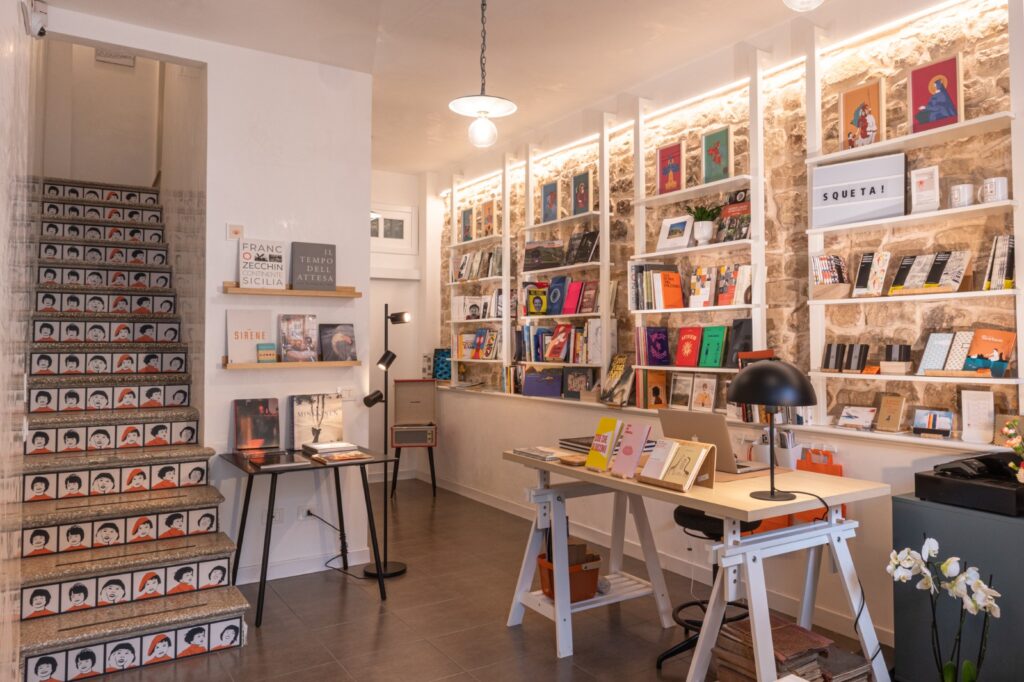
Zazie books, Modica
There are not many specialized bookstores that I know. My favorite used to be in Paris, at the Jeu de Paume, fifteen years ago: there were piles of books everywhere, it was like entering a magical cave, and I never left without a new volume. Now management has changed, everything is very orderly, and there are no longer so many surprises.
A museum bookstore is also that of the National Museum of Photography in Cinisello Balsamo (Milan). The only Italian public museum dedicated to contemporary photography, it has a collection of over 2 million photographic works, including black-and-white and color prints, slides, negatives, videos, installations by over 1,000 Italian and foreign authors, and a large specialized library with 20,000 volumes and magazines: the largest in Italy.
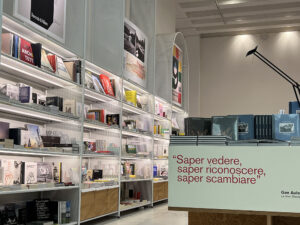
Triennale, Milano
Centers dedicated to photography have their own museum bookshops and tend to present volumes and catalogs of past and current exhibitions, giving more space the publisher who won the bidding process. Such are Camera – Italian Center for Photography in Turin and Le Stanze della Fotografia in Venice. The Triennale in Milan used to be large and rich in suggestions, favoring architecture and design but also having its own photography section. Now it seems to be becoming the corner of a publishing house. What a shame.
 |
 Rare photobooks at Micamera |
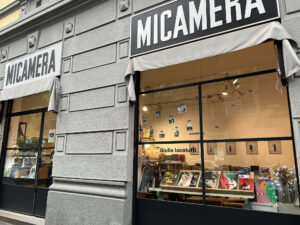
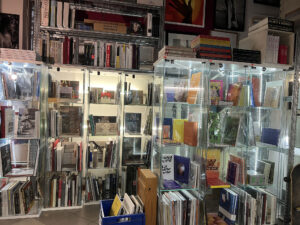
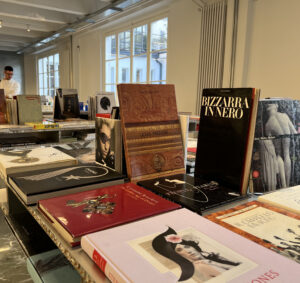
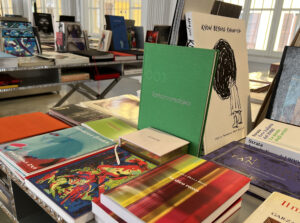
Then there are commercial research bookstores, which can also offer old, rare books without ISBNs. Micamera in Milan has a catalog of over ten thousand items, including new books, rarities, curiosities, and collectible editions, often foreign. It organizes photography courses, exhibitions, book presentations, and signings. Like the old Jeu de Paume, they always have some unusual title that is hard to resist. Also in Milan there is the bookstore of 10 Corso Como, where you can find new and rare books, a lot of fashion but not only that. After all, the space was born as a fashion concept store, with women’s and men’s clothing, shoes, jewelry, a restaurant, exhibitions, and perfumes. Both the perfume expert and the bookstore director are very knowledgeable and have many interesting things to share.
 10 Corso Como, Milano |
 |
Finally, there are festivals with their photobook competitions and related awards. Here too, I will only write about those I know. I apologize to all those I do not mention. For example, at Paris Photo the Aperture PhotoBook Award takes place every year, with prizes in three categories: First PhotoBook, PhotoBook of the Year, Photography Catalog of the Year. I look at the shortlist—covers, titles, and names—and discover that artists who design their own books, as I do, are a small minority. Almost all turn to a designer. Aperture is too important for me to speak about it, so I will let them speak from their website: “Aperture is a nonprofit publisher that leads conversations around photography worldwide. From our base in New York, Aperture connects global audiences and supports artists through our acclaimed quarterly magazine, books, exhibitions, digital platforms, public programs, limited-edition prints, and awards. Established in 1952 to advance “creative thinking, significantly expressed in words and photographs,” Aperture champions photography’s vital role in nurturing curiosity and encouraging a more just, tolerant society.”
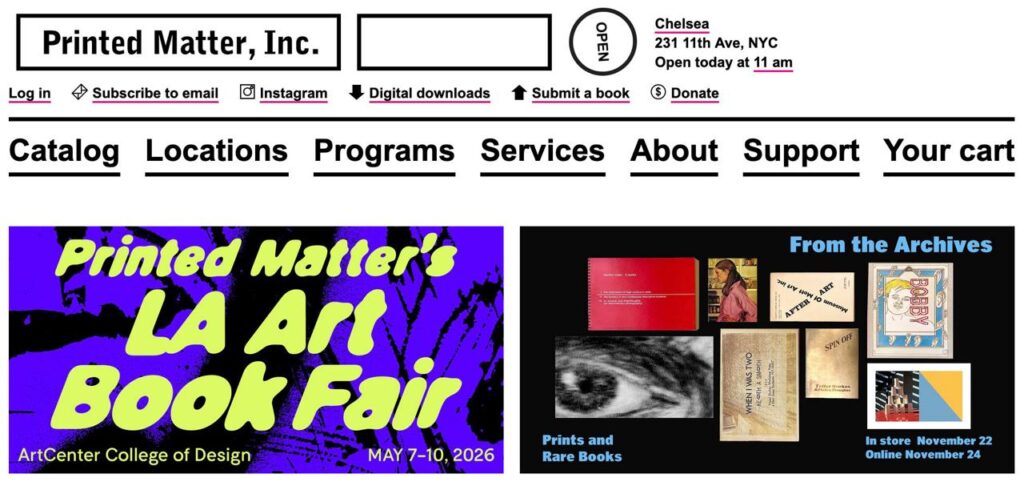
In New York, since 1976, there is also Printed Matter, which supports the distribution, understanding, and appreciation of artist books and related publications, with a large bookstore, an exhibition area, and spaces for consulting the archive. Their website, while celebrating fifty years of activity, says: Starting in the early 60s, many of the pioneering conceptual artists (as well as performance, process, environment, sound and other experimental media artists) began to explore the possibilities of the book form as an artistic medium. Large-edition and economically produced publications allowed experimentation with artworks that were affordable and could circulate outside of the mainstream gallery system. Printed Matter provided a space that championed artists’ books as complex and meaningful artworks, helping bring broader visibility to a medium that was not widely embraced at the time.(…) Printed Matter founded the NY and LA art fairs (in 2006 and 2013 respectively), which have become the world’s largest venues for the distribution, investigation and celebration of artists books and art publishing.
I am not a fan of magazines, I prefer books, but recently I have started following AnOther Magazine, which describes itself as “A modern eye on fashion culture and ideas”, and has a section dedicated to photography and art. And fashion photography at the level of excellence of Vogue Italia in the 1980s. Camera Austria International is different: the magazine keeps a large archive of volumes, promotes photographer residencies and hosts public talks. LensCulture too has its annual call: the Critics’ Choice Awards, with a final exhibiton in London. Like Aperture, Printed Matter, and similar organizations—and like international photography fairs—festivals also find ways to reward photobooks. The Athens Photo Festival has three: APhF Dummy Award feat. Witty Books is reserved for book projects without a publisher; the winner will be published by Witty Books. The APhF Pick:24 Book jury gives an award by choosing among photobooks published in the last year. Unfolded Chapters is a celebration of the photography book: it digs into libraries and archives and rediscovers old editions. The idea, beautiful and not easy, is to give new life to the volume that becomes the theme of the year, reconnecting past and present through contemporary storytelling. The Singapore International Photography Festival (SIPF) is run by DECK, a charity full of ideas, which in addition to artist residencies offers courses and conferences on how to create photobooks and on the future of art publishing. They recently had a conversation on how to construct the artist’s book: the ideas, decisions, and processes behind making an artist’s book—from initial concept to material form. They also organize a competition for very young photographers, aged 13–25, in two categories: Junior and Youth, with the claim “Let the Prizes Support You!” At 15 or 20, receiving a cash prize and photography materials and participating in an international festival is certainly a great encouragement. Good luck!
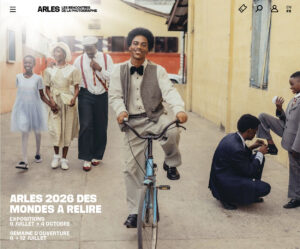
In 2026, Les Rencontres de la Photographie in Arles explore the role of photographic images in publishing for young audiences. The exhibition offers a historical and thematic exploration of photobooks for young people, from 1930 to today. Their photobook competition is called the Dummy Book Award.
2026 is also the year in which, especially in France, the 200th anniversary of photography is celebrated, starting from View from the Window at Le Gras by Nicéphore Niépce (1826): the first durable image written with light. In France, nearly 180 exhibitions are planned, from associations to art schools, from the Jeu de Paume to the Louvre, from Grenoble to Nantes, from Arles to Fort-de-France in Martinique. And if not all, the vast majority will have a book or a catalog. Specialized archives will have to catalog many new volumes (and we all know how archiving can be quite overwhelming).
Around the world now awards, competitions, festivals and fairs of photography and photobooks are so many that I cannot make a list: better to ask Google and AI, they will also tell you about calls and deadlines.
carla-vasa4-end.mp4