Theme Table of Contents
VJIC Table of Contents
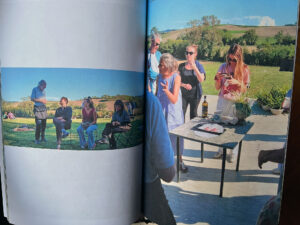
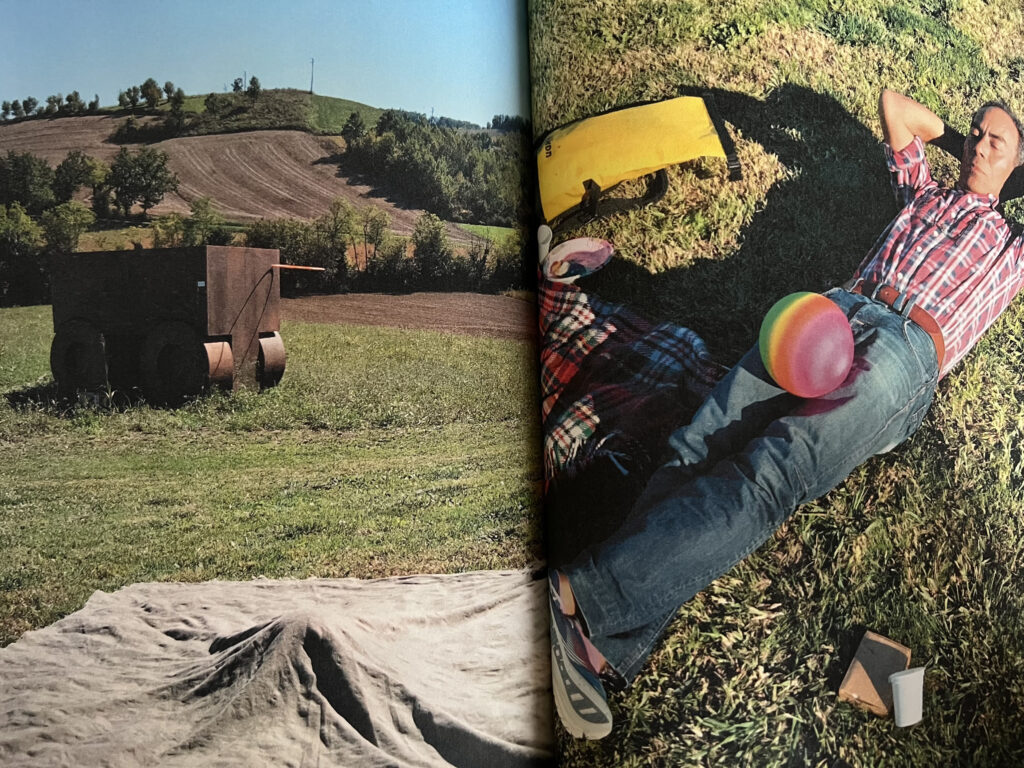
This chapter talks about a contemporary Déjeuner sur l’herbe. A pure photobook, capable of conveying—even to those who weren’t there—the richness of a country celebration, a Saturday among artists and friends: as if you were there. Each invited artist brought their own contribution. (Unfortunately for me, these initiatives are always in places unreachable by train, and I don’t drive.) Many also contributed photographs. In the end, Ermanno Cristini—who conceived the collective party/exhibition/performance and selected the participants—and Giancarlo Norese—who, in addition to being an admirable editorial designer, is a publisher, artist, painter, and sometimes teacher—designed and produced the photobook (print on demand on Amazon). Thus a single day became something that remains, a memory you can leaf through.
Inside, the subtitle reads:
a project by Ermanno Cristini in conversation with Giancarlo Norese
and Susanna Baumgartner, Cesare Biratoni, Sergio Breviario, Giuseppe Buffoli, Emma Damiani, Claudia Mangone, Gloria Tamborini, Luisa Turuani
But before a brief introduction by Ermanno, there are also the photographic credits (and this makes clear how collective the project is):
Umberto Cavenago, Ermanno Cristini, Emma Damiani, Al Fadhil, Giancarlo Norese, videoforart
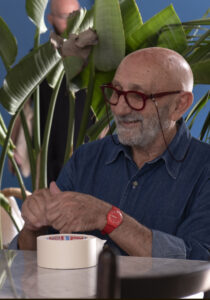
Ermanno Cristini
CDB: Ermanno, you often design exhibitions and magazines that you realize with others. How do you define them? Participatory? Relational? Just as often you then turn them into books, but also magazines: in my collection of artists’ books you are the most present, yet I own only a tiny fraction of them. You like paper, printing, reading, yet sometimes you invite people to look, almost without words.
How did you organize this Déjeuner sur l’herbe? Did you already know you would make a photographic book out of it?
 EC: This Déjeuner sur l’herbe came about by chance, or through “happy coincidences,” as practically always happens with the things one does—and also with those one doesn’t do. I like to think that all my work develops through “stumbles,” that is, through encounters with elements that disturb the “straight path.”
In this case, on the property of Liliana and Lorenzo Baldi in Serralunga di Crea, La 74, Umberto Cavenago’s steel alcove, was temporarily installed—a mobile, inhabitable sculpture dwelling parked there while waiting to go elsewhere. It was precisely around Cavenago’s nomadic sculpture that the Déjeuner sur l’herbe took shape: a tribute to art, its history, and to a convivial vocation of artistic practice.
Convivial among artists, among artists and artworks, among artists, artworks, and the place. Among artists, artworks, the place, and the public. There is certainly a participatory, relational dimension, but perhaps art has always had a participatory dimension, even if in very different forms that appear impervious to relation. An erotic relation, as the subtitle in parentheses states. Not only in reference to Cavenago’s alcove, but because the exercise of language is erotic at the moment when it traverses the unpredictable edge of its transformation.
And then… things never end where they first appear; they travel and transform. This is the meaning of the book—not that of an exhibition catalogue, but of a testimony, a narrative made with another language, the language of the photobook in this case. The photographs, taken by different authors, represent a necessarily interpretive narration and therefore one endowed with a life of its own. Different eyes, intersecting gazes, drawing a multiple reading path.
This implies a conception of the work grasped in its impermanence, made of continuous transformations, and a vision of authorship situated in the dialectic of an “unavowable community,” in the sense the term had for Maurice Blanchot.
CDB: Ermanno, for years you have had an exhibition space, shared with other artist-curators, yet you are able to find opportunities for one-day or one-week exhibitions in experimental galleries, abandoned but not dangerous factories, suburban courtyards, the former slaughterhouse of Milan… Not all these events have a book of their own. Do you know from the start that you will make a book, or do you decide later, as I do? And how do you realize a project, how do you make a book like Déjeuner sur l’herbe? How do you organize it all? How long does it take?
EC: Opportunities present themselves if one wants to see them. The space of the “exhibition” is a determining element; there is no work without the space of its exhibition—indeed, the exhibition space effectively coincides with that of creation. Even when the work is born in the studio, because as soon as it goes out and travels the world it becomes another work, and
It is this vertigo of transformation that interests me, and it is in this spirit that the exhibition itself—whether one day or one month, the exhibition understood as the materialization of the work within a choral dimension—projects itself beyond its time and space, investing other languages, for example that of photographic images gathered in a book. Time is always long, even if the exhibition lasts an instant: its gestation and its projection live in the dense, slowed time of thought, which is the antithesis of the scrolling time into which we are today pushed, more or less against our will.
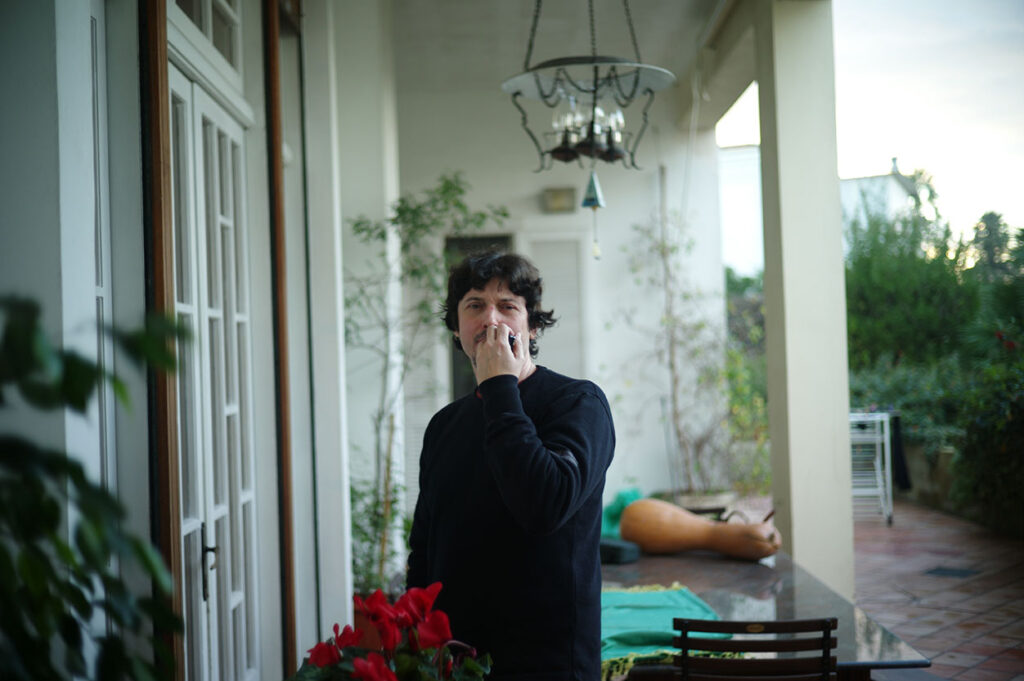
Giancarlo Norese
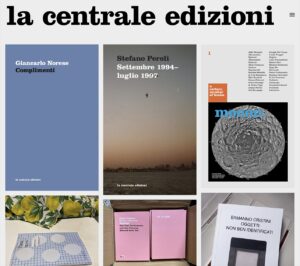
CDB: Giancarlo, as you know, I am a great admirer of your website and of the winged calf for the Suzzara Prize, a citation of the Lion of the Venice Biennale. I have also published a book with you, Herstories, and you patiently revised and refined my imperfect layout. I’ve known you for years and see many of the books you publish with la centrale, also known as la c., a collective, non-profit publishing project. You collaborate with many artists, and every book is different. But how do you organize yourself when you have to make a photobook without texts? I help myself with words; you—how do you do it? For example, Déjeuner sur l’herbe: how did you get to that famous Saturday in September? And then to making the book?
GN: I started making books to document collective projects (like Oreste*, the first network of Italian artists and curators, at the end of the 1990s) and because no one else wanted or was able to dedicate so much time and care to a demanding, problematic, and thankless activity like publishing. For me, making collaborative books is an extension of my artistic practice, in the same way that I paint, see exhibitions, go to the academy, and even go to the bar. Sometimes I publish one book a week, other times—like right now—dozens of unfinished projects clog up my hard drives.
With other artist friends, I have been experimenting for years with an inexhaustible range of different “displays”, consisting of one-day exhibitions, hidden exhibitions, exhibitions without curators or where everyone is a curator, and publications of all kinds. When something instantaneous happens, like the Déjeuner sur l’herbe exhibition, I quickly collect the snapshots taken by the participants and, if I have no distractions or impediments (like having too much free time), the book is done within 48 hours. I would also tell you about the new black-and-white magazine we are creating, modeled after Marcatrè, but we swore not to put any photos in it, and therefore it would be an irrelevant answer to your request.
* Oreste’s importance was acknowledged by its participation in the 48th Venice Biennale in 1999 (invited by Harald Szeemann as part of the dAPERTutto exhibition). Instead of presenting finished works, Oreste transformed its space into a “relational room” for ongoing meetings, performances, and discussions for four months, the entire duration of the event.
CDB: Both of you, please tell me about other books, other authors, magazines—so long as they contain many photos. I like to better understand how you work, but the theme of this series of articles is books with photographs, and the various methods of getting there.
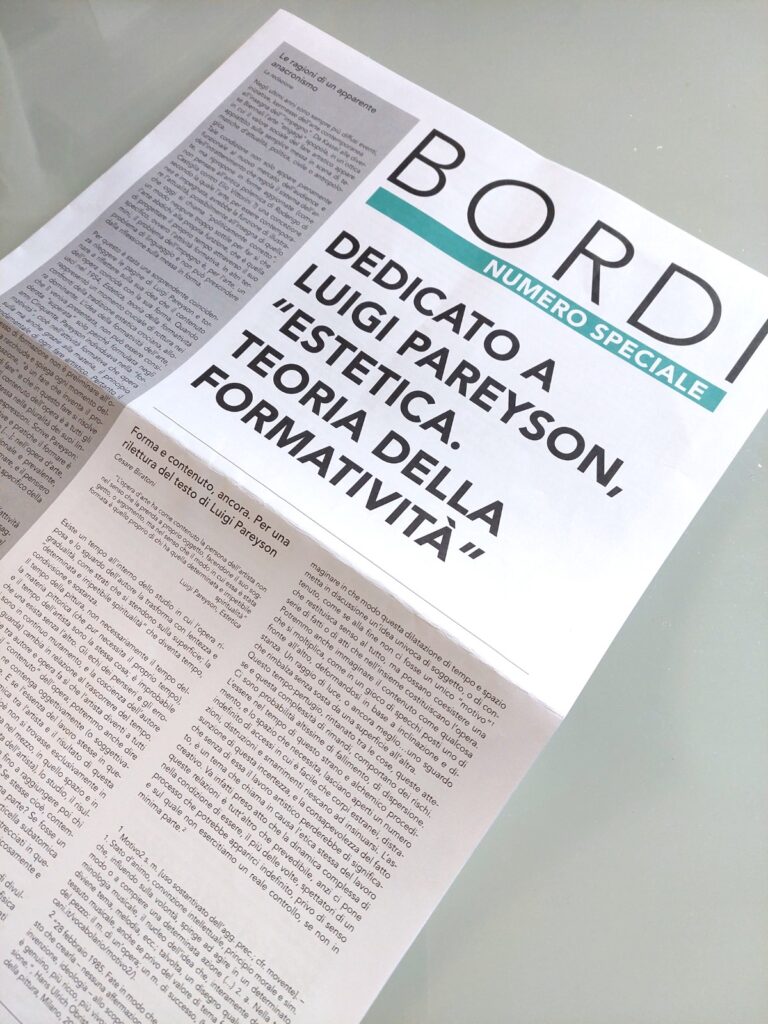
EC: In the end, even though I like to write, my history has led me to play above all with images. So almost all the books I have made are books of images, always conceived as a work or an integral part of the work, never as documentation of something external to them.
The magazines Strabismi and Bordi, which I curate respectively with Luca Scarabelli and Cesare Biratoni, and always with the complicity of Giancarlo Norese, instead, leave room for text, seeking a balance between text and image to create spaces for theoretical reflection.
From this point of view, the latest—and most extreme—adventure is Dromedario, where there is no space for images: no photos, only dense black-and-white texts, boring and of little appeal, to be read at a desk with pen in hand or placed on the bedside table for an intimate rereading. The exact opposite of art magazines, to be leafed through at leisure, glossy and full of photos!
 CDB: Except the ones published with Amazon, and signed la a., most books by Cristini, Norese and friends don’t have an ISBN. A reader of the first chapter of this series didn’t agree with my suggestion of the possibility, forgetting (though it wasn’t the only choice suggested) that 1) these books are like art multiples: there is no ISBN on photos, paintings or sculptures; 2) these editions work somehow like exhibitions, and integrate them; 3) no matter how legally ISBNed they are, critics very rarely review books, be they written, illustrated or photographic, except when the authors are already famous; 4) distribution of art books is never as good as authors and publishers would like; 5) sometimes artworks become urgent and artists are in a hurry to show them, while publishers, curators and galleries take months to examine proposals. A book, even a self-published one, is a fact and helps to shorten the waiting time.